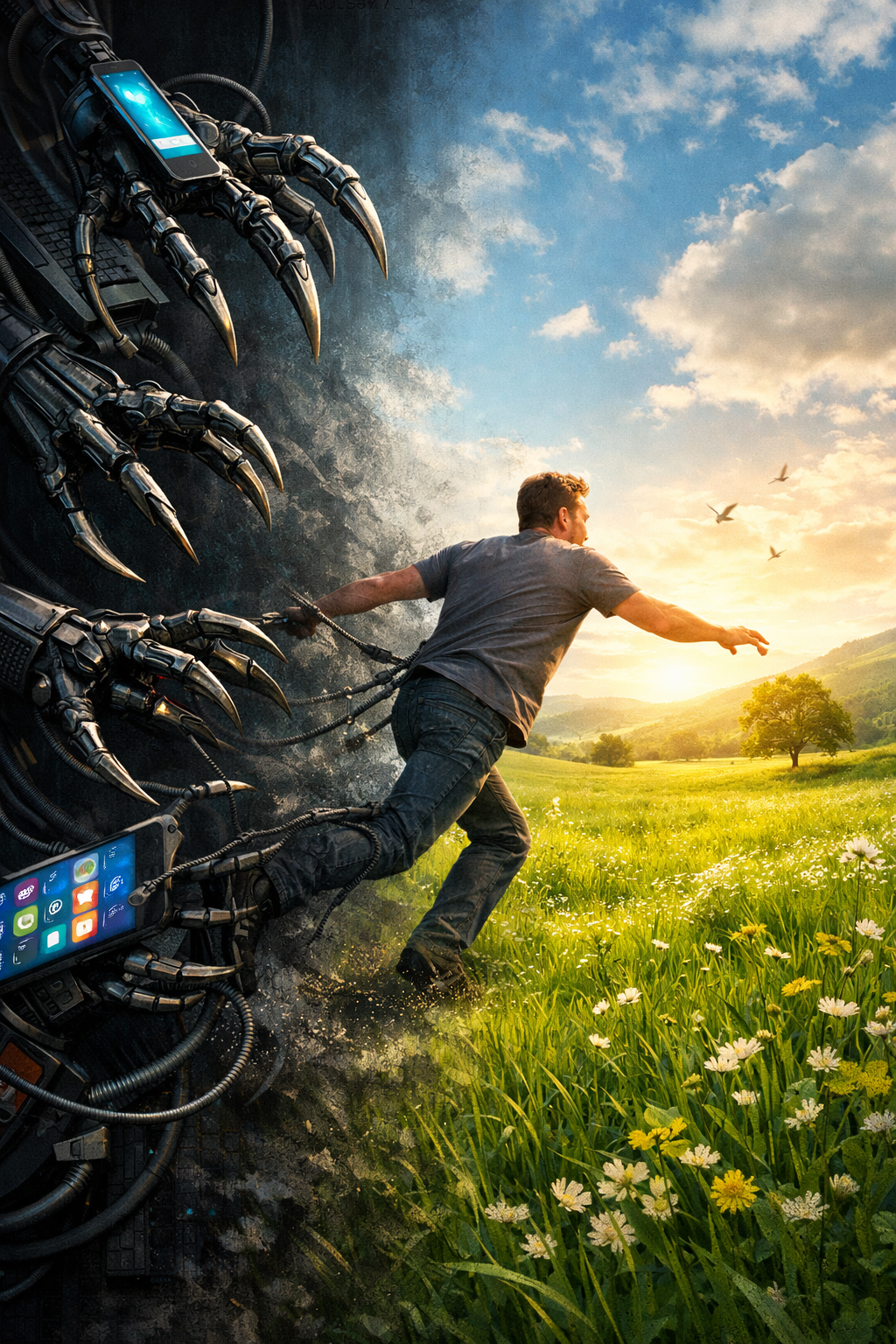
Is a Digital Detox worth doing?
20,000 hours across multiple games is the time I have amassed sitting there, staring at a screen. That’s 833 days, or 119 weeks, or 27 months, or 2.28 years. Can you imagine sitting in a chair for 2.28 years, staring at a computer screen?
When I looked into how much time I had spent on games and broke it down into years, months, and days, it really put it into perspective.
I would hope with such a huge sacrifice that I would have something to show for it — a skill perhaps? Nope. Nothing. I had not made any money from it, no real-world transferable skills, and barely any memories of the “good time” I had while playing.
This isn’t a theory or a statistic for me — I’ve tested this pattern repeatedly in my own life.
You start to feel stupid. All that time… Imagine the things I would know or be able to do if I spent that time doing something else.
Obviously I could have used that time productively — learn a language, an instrument, read, hobbies, sports. All valid. Though knowing that is not enough to make you quit.
You could justify that the game itself is a skill, an instrument, a sport, reading — whatever — and that all of it is just as much of a waste of time as gaming or being on your phone.
Imagine adding up all the hours you’ve spent on all these other things on top of gaming. Pretty scary thought. Studies suggest on average we spend 17–21 years of our life staring at screens, with 4–5 years of it being a phone.
Though knowing these statistics still wasn’t enough to push me towards the digital detox — and detox implies short term, I plan on sustaining this for life — it was the recognition and understanding that I did not enjoy anything in life anymore, and I knew that wasn’t normal.
I didn’t want to go through life just going through the motions, doing what I think I’m supposed to be doing. Numb.
Everything felt grey.
I would go out and do things hoping that if I just continued doing what I used to do, that “real” feeling of reality might magically come back. It didn’t.
I have sold and bought computers a dozen times. Every time I recognised that my enjoyment of life vanished when I had one and was spending too much time on it.
I would go almost a year without a computer, and each time relationships improve, I start feeling good, my moods are better, I have better conversations, I relax more, and enjoy the simple things.
But slowly, over time, I forget and start to romanticise the “good” times I had gaming.
Hey, I feel stronger now. They weren’t even that bad. I just need to control the time spent on it. Easy.
I start to justify my circumstances.
Life’s good now — this won’t affect me.
Or the opposite — life’s shit, I’m just waiting at the moment, I need a distraction. What else is there to do? Drink? This is healthier.
So I get another one. Fun at first, yes. But after a while it becomes dull and I realise I’m really just doing it out of habit. Addiction. I’m not enjoying it, I’m just getting my fix.
Then inevitably things start to lose their appeal. I get bored easily. I want to escape conversations. I can’t relax. I can’t truly enjoy anything.
This doesn’t only apply to gaming.
I would sell the PC, think I’m doing great, then realise I’ve just replaced it with consuming copious amounts of YouTube or being on my phone all the time.
I used to think it wasn’t that bad. I’m consuming informational videos, googling questions, looking at things I planned to do.
The problem is it’s all consumption. It doesn’t matter what it is — if you’re not doing anything, you’re still doing nothing.
At least games made you do something for your dopamine hit.
I came to the conclusion phones are just as bad, if not worse.
Everything about them — even how contactable you are — pulls you out of the moment you’re in. Your attention is gone. Your thoughts, your peace, are never really there when you have a supercomputer in your pocket, and your subconscious knows it whether you use it or not.
So I ended up getting a “dumb phone”. I think one day they’ll swap the names — smart and dumb — and the only real smart people will be the ones without apps.
I stopped watching YouTube and sold the PC. I needed a PC with a good graphics card to edit high-quality videos, but I had to make the sacrifice.
The old-school phone took some getting used to. Texting was button-based and tedious. No apps meant carrying a wallet again and memorising directions before leaving the house.
I’ve quit smoking before, but wow — this was a lot harder.
I was angry, restless, agitated. I lost motivation and just sat around the house, staring out the window, ruminating over and over.
I would open the old laptop and start googling scientific studies about gaming, reading forums, trying to find a loophole that proved it was actually good for you.
I wanted a way to justify getting another PC.
There were certain times of the day when it was worse. Always around 4pm.
There was a local store that sold a gaming laptop I wanted. They closed at 6pm.
For two hours every day I argued with myself. Back and forth. Coming at it from bizarre angles, trying to find a loophole that would let me justify it without feeling like a loser for giving in.
Once it was too late to get there and buy it, I could finally relax.
The agitation went away.
Cravings don’t last. They always eventually die out.
At the end of the day, there really is no benefit to gaming or consuming brain rot in your downtime. The second you give yourself a little, the whole thing comes crashing down.
The benefits of pushing past the suffering, however, are life-changing.
After a while of being off technology things started improving. Time slowed down, Emotions came back, I laughed more, I stopped hating everyone I came across and Even food started to taste better.
Before, the only thing that would wake me up was fast-paced competitive action — beating another human. It’s fun, but you can’t live in that state. Everything has a cost.
If you’re thinking about doing this, it is 100% worth trying. Why not make it an experiment? At least a month. Don’t try a few days or a week — you’ll never get past the withdrawal stage. For people more addicted to devices and games, I’d give it six months.
The key is not going back. Every time you quit and start again, you reinforce that pattern, and each attempt becomes harder than the last.
It will be hard. That’s certain.
But once you reach the other side, you’ll understand why it is worth it.
You’ll sit there quietly, look back at yourself in the past, and thank the version of you who chose discomfort — because they gave the future you a fuller life.